
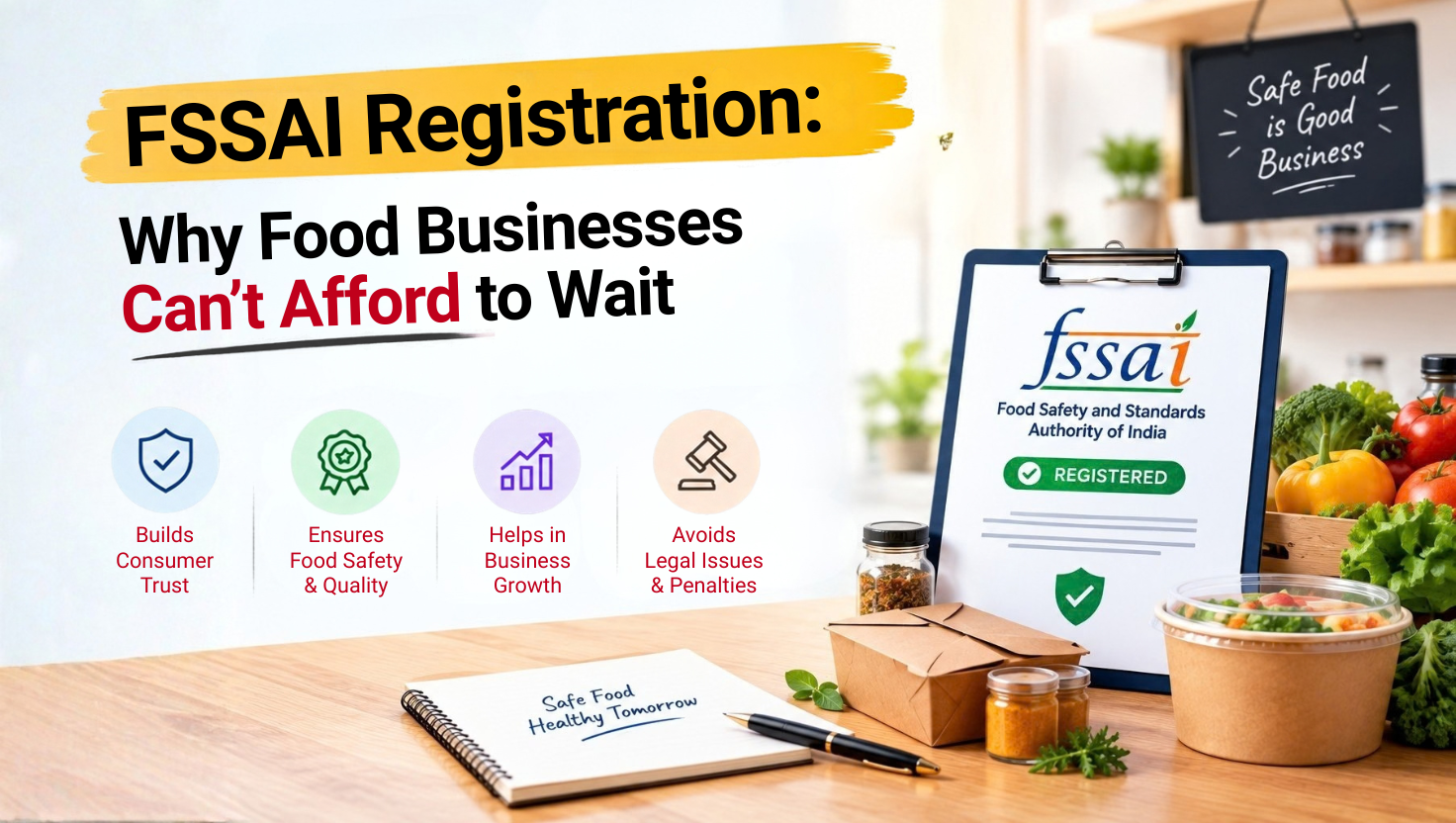
Quick answer: Any business manufacturing, storing, distributing, or selling food restaurants, cafes, cloud kitchens, or stalls needs FSSAI registration under one of three tiers based on turnover: Basic, State, or Central License. Operating without it risks penalties, enforcement action, or a forced shutdown.
Food businesses tend to prioritize everything visible to customers menu, ambience, delivery speed while FSSAI registration sits quietly in the background until an inspection, complaint, or platform onboarding brings it up. By then, operating without it isn't a minor oversight, it's a compliance gap that can shut a business down mid-operation.
What FSSAI Registration Actually Is
The Food Safety and Standards Authority of India (FSSAI) regulates food safety nationwide, and any entity manufacturing, processing, storing, distributing, or selling food needs some form of FSSAI registration or license. It confirms a food business meets baseline safety and hygiene standards, not just that it exists as a registered entity.
Who Needs FSSAI Registration
This applies broadly, not just to large manufacturers:
- Restaurants serving dine-in or takeaway
- Shops selling food products, packaged or otherwise
- Cafes and small eateries
- Cloud kitchens operating delivery-only, without a storefront
- Food vendors and stalls, including smaller, seasonal operations - see our guide to why every food stall needs FSSAI registration for the vendor-specific view
A common misconception is that FSSAI only applies to physical dine-in spaces. Cloud kitchens need it just as much, since delivery platforms typically require a valid FSSAI number before onboarding a vendor.
The Three Tiers of FSSAI Registration
- Basic Registration: small businesses and petty food operators below a turnover threshold
- State License: medium-sized businesses operating within a single state
- Central License: larger operations, multi-state businesses, or those importing/exporting food
Registering under the wrong tier - Basic when your turnover already qualifies for State, or vice versa - creates compliance issues later. Rules around thresholds and categories do shift; our breakdown of recent FSSAI rule changes affecting Odisha food businesses is worth checking before you apply.
What Happens Without Valid Registration
This is the part most food businesses underestimate. Operating without valid FSSAI registration is an active enforcement area; inspections happen, and without registration, a business can face penalties, legal action, or an order to stop operating entirely. A shutdown doesn't just cost revenue for the days it's closed; it damages customer trust in a sector where trust is the main thing being sold.
Just Launching Your Food Business?
FSSAI registration is only one piece. If you're formalizing a new food venture from scratch, choosing a structure, registering the business itself, Auditfiling's startup registration service covers that groundwork alongside your FSSAI application.
Frequently Asked Questions (FAQ)
Q1. Does my cloud kitchen need FSSAI registration without a storefront?
A: Yes. FSSAI applies to food preparation and sale regardless of a physical dine-in space, and most delivery platforms require it before onboarding.
Q2. How do I know which FSSAI tier applies to my business?
A: It depends on annual turnover and scale - Basic for small operators, State License for mid-sized single-state businesses, Central License for larger or multi-state operations.
Q3. What happens if I operate without FSSAI registration?
A: Penalties, enforcement action during inspections, and potentially an order to stop operations until compliance is sorted.
Q4. Do small food stalls and vendors need FSSAI registration too?
A: Yes, usually under Basic Registration - simpler, but still mandatory.
Q5. Can I apply for FSSAI registration online?
A: Yes, through FSSAI's online portal.
Q6. Does FSSAI registration need renewal?
A: Yes, it's issued for a defined validity period and must be renewed before expiry.
Register Before the Inspection, Not After
FSSAI registration isn't a formality that can wait until a business is established - it's a requirement from day one of selling food. Businesses that register early avoid the far more disruptive alternative: an inspection finding the gap first.
To start your FSSAI registration, or to set up your food business the right way from day one, reach out to Auditfiling now.